Blog
Plain-English articles for getting your measurement and structural models past review — how to report CFA and SEM fit, check discriminant validity, and run the whole study in one place.

How to Report CFA Results in APA Style (With Template)
Report CFA results in APA: fit indices, loadings, reliability, AVE and HTMT — with cutoffs and a draft paragraph you can edit.
Read article
HTMT vs Fornell-Larcker: Discriminant Validity Guide
HTMT vs Fornell-Larcker for discriminant validity: thresholds (.85/.90), worked examples, and why HTMT is now preferred.
Read article
Free Qualtrics Alternative for Your Thesis (2026)
A free Qualtrics alternative for a thesis: build the survey, collect data, and run CFA/SEM analysis with APA output in one place.
Read article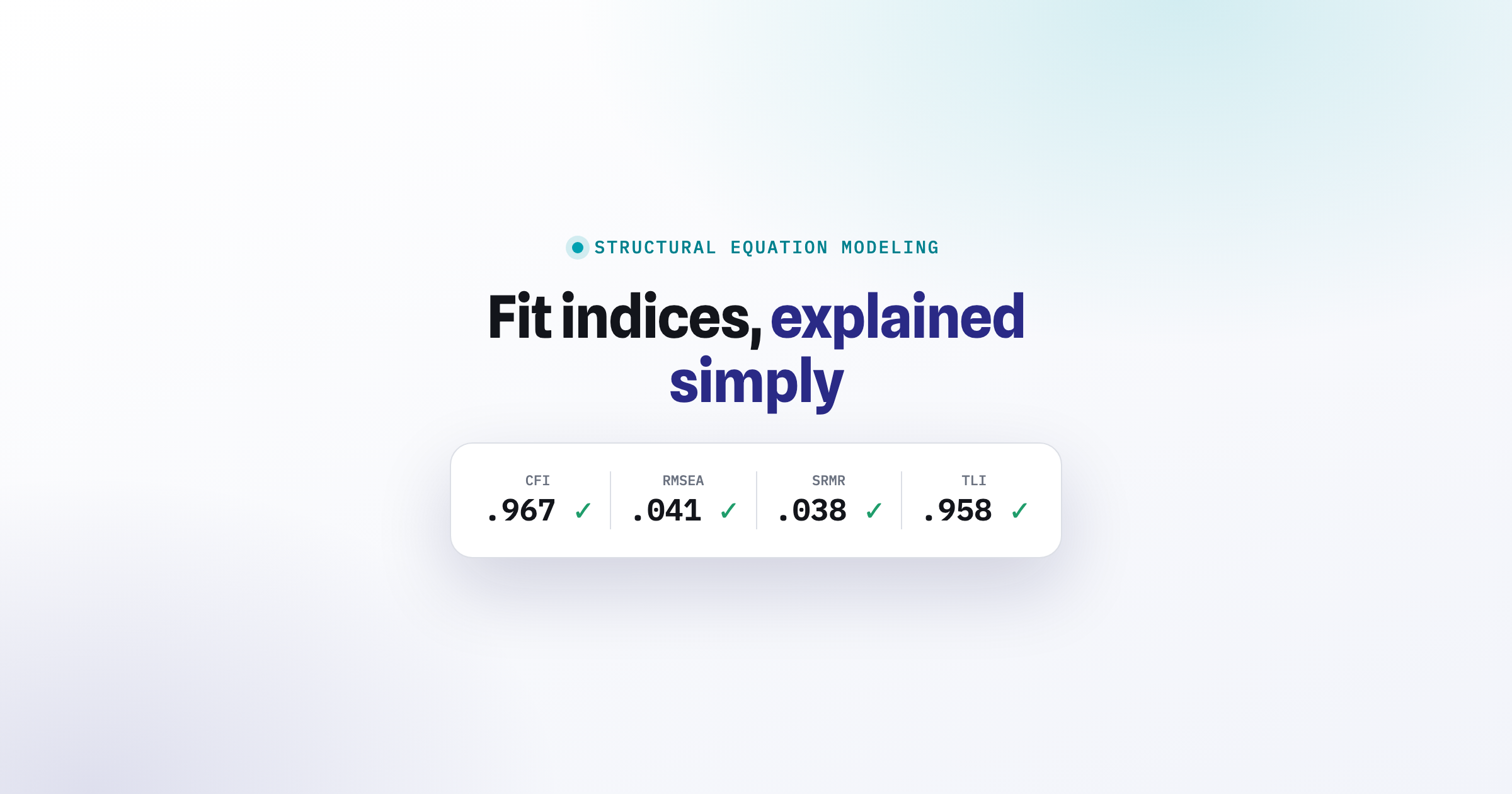
How to Report SEM Fit Indices: CFI, RMSEA, SRMR
How to report SEM and CFA fit indices in APA style: χ², CFI, TLI, RMSEA with 90% CI, and SRMR, plus a worked example and the exact wording.
Read article
Your First Study: Build a TAM Survey and Run CFA and SEM
TAM questionnaire tutorial: four constructs, 14 validated 7-point items, collection on Prolific, then CFA (CFI = .985) and CB-SEM, with Methods text.
Read article
How to Find a Validated Scale for Your Research
How to find a validated scale: search Google Scholar and compendia, judge α, CR, AVE, and HTMT, and cite the original authors correctly.
Read article
How Many Participants Do I Need? Sample Size Planning
How many participants do I need? Plan sample size before data collection with a-priori power analysis, SEM rules, and dropout adjustment.
Read article
From Research Question to Questionnaire: Step by Step
Turn a research question into a questionnaire: define constructs, choose validated scales, name variables, and build your survey — step by step.
Read article
How to Write Good Survey Questions: A Practical Guide
How to write survey questions that work: avoid common flaws, choose the right scale, handle reverse items, and adapt for non-native respondents.
Read article
How to Recruit Participants on Prolific
How to recruit participants on Prolific: demographic filters, a fair pay formula with a worked example, platform fee and VAT, attention checks, exclusions.
Read article
When to Use Conjoint Analysis: Is It Right for Your Study?
When to use conjoint analysis: trade-offs vs simpler rating questions, choosing attributes and levels, ratings-based vs choice-based, and study design.
Read article
SmartPLS Alternative: Run PLS-SEM in Your Browser
Looking for a SmartPLS alternative? Explonia runs PLS-SEM in the browser — no install, no per-seat license, survey and analysis in one place.
Read article
Run CB-SEM Online Without R: Explonia vs lavaan
Run CB-SEM and CFA online without R: Explonia's results are checked against lavaan on shared data. Visual builder, APA output, one place.
Read article
Get Supervisor Sign-Off Before Fieldwork
Get supervisor sign-off on your survey before fieldwork: what an advisor should check, why review beats fixing data later, and how to share a read-only study.
Read article
HTMT Above 0.90: What to Do (and What Not to Do)
HTMT above 0.90? Diagnose the cause first — item or construct overlap — then use bootstrap CIs, merge constructs, or drop an item with reasons.
Read article
PLS-SEM vs CB-SEM: How to Choose (Without Dogma)
PLS-SEM vs CB-SEM: CB-SEM for theory testing with global fit, PLS-SEM for prediction and composites. Decision table, two myths, worked scenarios.
Read article
Attention Checks in Online Surveys: What Still Works
Attention check survey questions: why one 'select X' item fails, how to hide a bogus item in a scale, exclusion rules, and what Prolific lets you reject.
Read article
Common Method Bias: Prevention Beats Detection
Common method bias: why the Harman single factor test settles nothing, and which questionnaire design choices reduce it. Remedies, check battery, example.
Read article
How Many Points Should a Likert Scale Have?
How many points a Likert scale needs: gains level off near six options, labels matter more than the count, and the midpoint is a design decision.
Read article
Where to Recruit Survey Participants (and What Goes Wrong)
Where to recruit survey participants: panels, MTurk, social media, snowball and student pools compared, with the risk each source adds to your data.
Read article
HARKing: Why Not to Write Hypotheses After the Data
HARKing is presenting a hypothesis written after the results as if it came first. Why it breaks your test and how to fix hypotheses before data collection.
Read article
Full vs Partial Mediation: Why the Labels Are Outdated
Is full mediation outdated? Yes. Full vs partial mediation labels depend on sample size: test the indirect effect with a bootstrap CI instead.
Read article
Types of Survey Scales: Choosing the Right Response Format
Types of survey scales compared: Likert, semantic differential, slider, ranking, constant sum. Choose each format by the analysis you plan to run.
Read article
Survey Screening Questions and Skip Logic: A Practical Guide
Survey screening questions and skip logic: write screeners that hide who qualifies, route respondents, plan N per branch and report screen-outs.
Read article
Survey Question Order: How to Avoid Order Effects
Survey question order changes answers. Where to put demographics, the dependent variable and attention checks, and when to randomize questions and blocks.
Read article
Conjoint Analysis Design: 9 Decisions for Your Thesis
Conjoint analysis design for a thesis: attributes and levels, number of tasks, D-efficient designs, ratings vs CBC, sample size, none option, pilot.
Read articleRun your whole study in one place
Design it, collect it, and get publication-grade analysis with APA output — free to start.
Start free